Guide
Lightning Whelk vs. Knobbed Whelk: A Field ID
Two large East and Gulf Coast whelks that look almost identical — until you notice which way they coil. A field-ready comparison for beginners.
Two large East and Gulf Coast whelks that look almost identical — until you notice which way they coil. A field-ready comparison for beginners.
Start Here: One Look Settles It
Hold the shell with the spire pointing up and the aperture (opening) facing you. If the aperture opens on the LEFT, you have a lightning whelk — the only common sinistral (left-handed) whelk on U.S. shores. If it opens on the RIGHT, you're looking at a knobbed or channelled whelk. Everything else on this page simply confirms what that first look tells you.
What the Two Shells Share
Both belong to the family Busyconidae, and both are large predatory sea snails of the U.S. east and Gulf coasts. That shared family explains why they are so easily mixed up on the strand.
- Large spiralled shell with a tall spire and a long, open siphonal canal running down the base.
- Broad, pear-shaped aperture, typically cream to pale orange inside.
- Shoulder ornamented with knobs or blunt tubercles, though how strongly varies between the two.
- Both live on sandy intertidal and shallow subtidal bottoms, and both wash in whole after weather.
How to Identify a Lightning Whelk
The lightning whelk (Sinistrofulgur sinistrum) is the sinistral one. Its aperture opens on the left when the spire points up — the diagnostic left-handed coil. The base colour is pale cream to grey, and juveniles carry vertical brown 'lightning' streaks down the spire that fade as the shell matures.
- Left-handed (sinistral) coil — aperture on the left.
- Vertical lightning streaks on juveniles, fading with age.
- Long anterior siphonal canal.
- Rounded shoulder with low knobs rather than sharp points.
How to Identify a Knobbed Whelk
The knobbed whelk (Busycon carica) is the dextral one — the aperture opens on the right with the spire up. Its shoulder carries a row of prominent knobs along the body whorl, and the interior is often flushed with orange. It is the state shell of Georgia and New Jersey.
- Right-handed (dextral) coil — aperture on the right.
- Prominent knobs along the shoulder of the body whorl.
- Aperture often tinted orange.
- Intact adult shells are less common on the strand than juveniles.
Key Differences at a Glance
| Feature | Lightning Whelk | Knobbed Whelk |
|---|---|---|
| Scientific name | Sinistrofulgur sinistrum | Busycon carica |
| Coil direction | Sinistral (left-handed) | Dextral (right-handed) |
| Aperture opens | On the left | On the right |
| Shoulder | Rounded, low knobs | Prominent knobs |
| Aperture colour | Cream to pale orange | Often flushed orange |
| Pattern | Brown lightning streaks on juveniles | Cream to grey, orange-lipped |
| Common range | Common on the Florida Gulf coast | Common on Atlantic beaches, Cape Cod south to Florida |
| Best field mark | The left-opening aperture | Knobbed shoulder with a right-opening aperture |
Where They Are Commonly Confused
Confusion happens most often with worn or juvenile shells, where the knobs have eroded down and the streaks have faded — leaving two pale, pear-shaped spirals that look interchangeable. It also happens in photographs, where a mirrored or flipped image reverses the apparent coil direction. Always judge coil direction from the shell in your hand, spire up.
Where You'll Find Them
Lightning whelks dominate the Florida Gulf Coast tide line — Sanibel, Captiva, and Marco Island produce whole adult shells after winter cold fronts. Knobbed whelks are far more common on the Atlantic barrier islands, from the Outer Banks up through Assateague. Range is a helpful supporting clue, but never the deciding one: both species stray, and coil direction always outranks location.
Which One Did You Find?
- Aperture on the left, pale with faded streaks, found on the Gulf coast — lightning whelk.
- Aperture on the right with a knobby shoulder and orange-tinted opening — knobbed whelk.
- Aperture on the right but the shoulder is smooth or channelled — likely another whelk in the group; compare against the whelk family page.
- Still unsure? Photograph both sides, spire up, in natural light before you leave the beach.
One reminder before you pocket either: never collect live specimens — check the aperture for a live animal first.
Learn where to find them.
Read the Florida Gulf Coast hubMore look-alike pairs, each with the one field mark that settles it.
Commonly Confused ShellsContinue Your Beachcombing Journey
Hand-picked next steps — chosen because they build directly on what you've just read.
Article
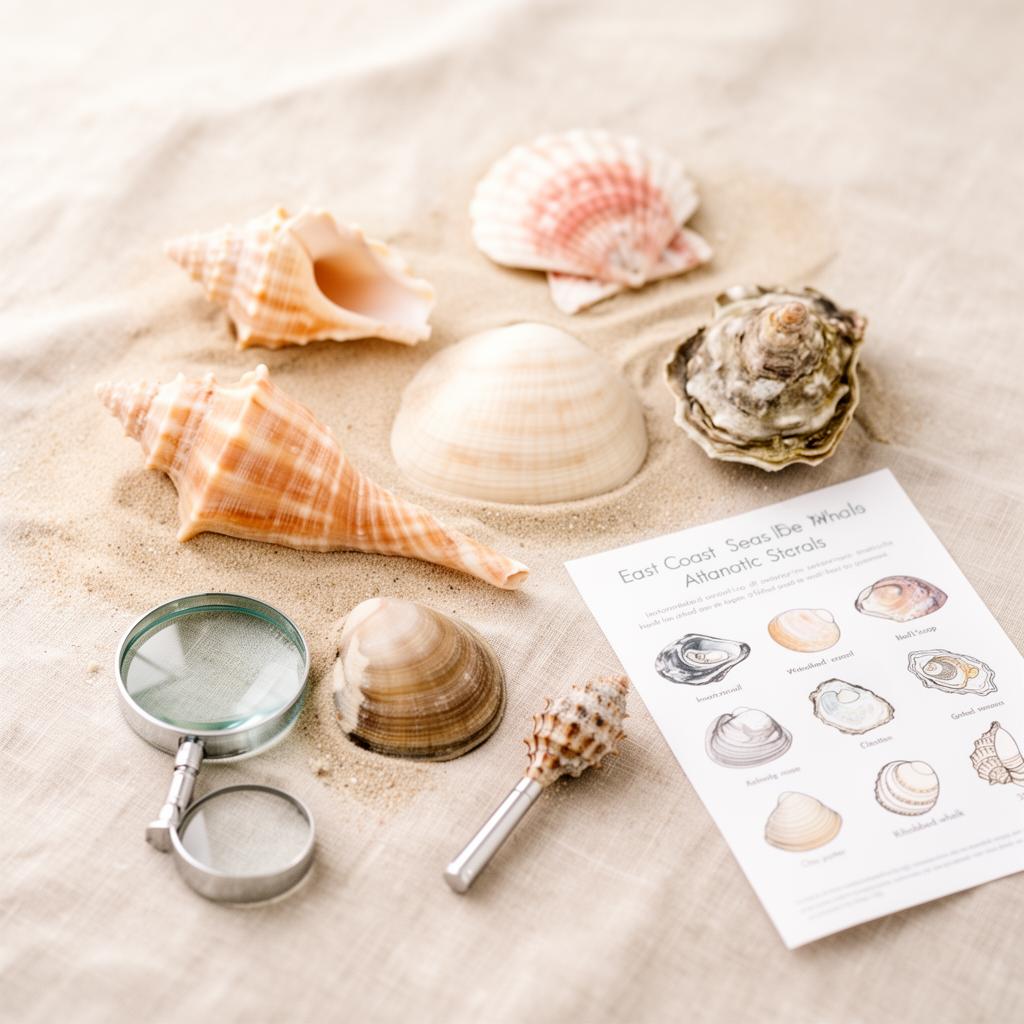
How to Identify Common East Coast Seashells and Where to Find Them
Builds on the same core topic.
Guide
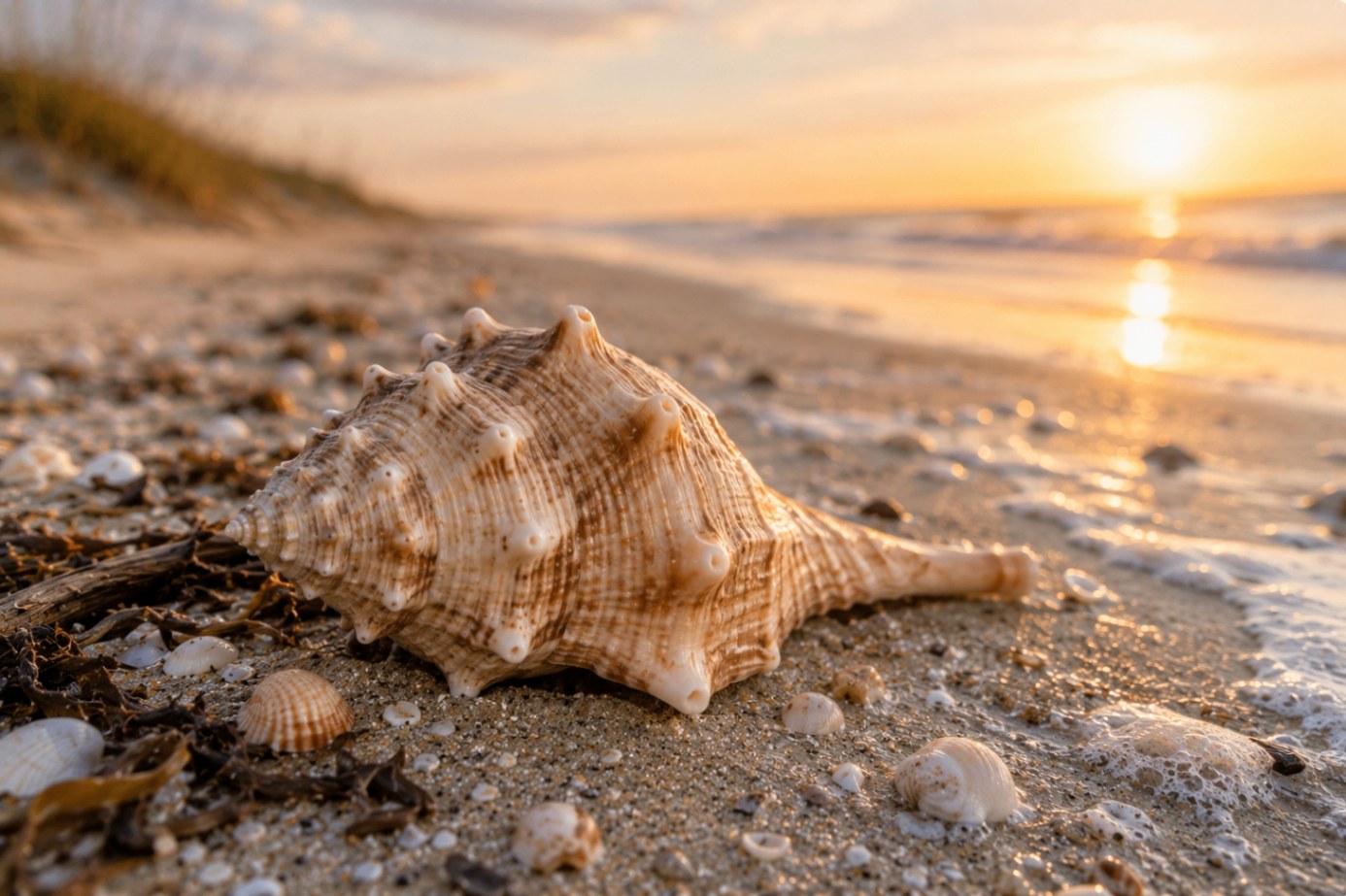
Commonly Confused Shells: A Side-by-Side Field Guide
Hand-picked next step from the editors.
Resource
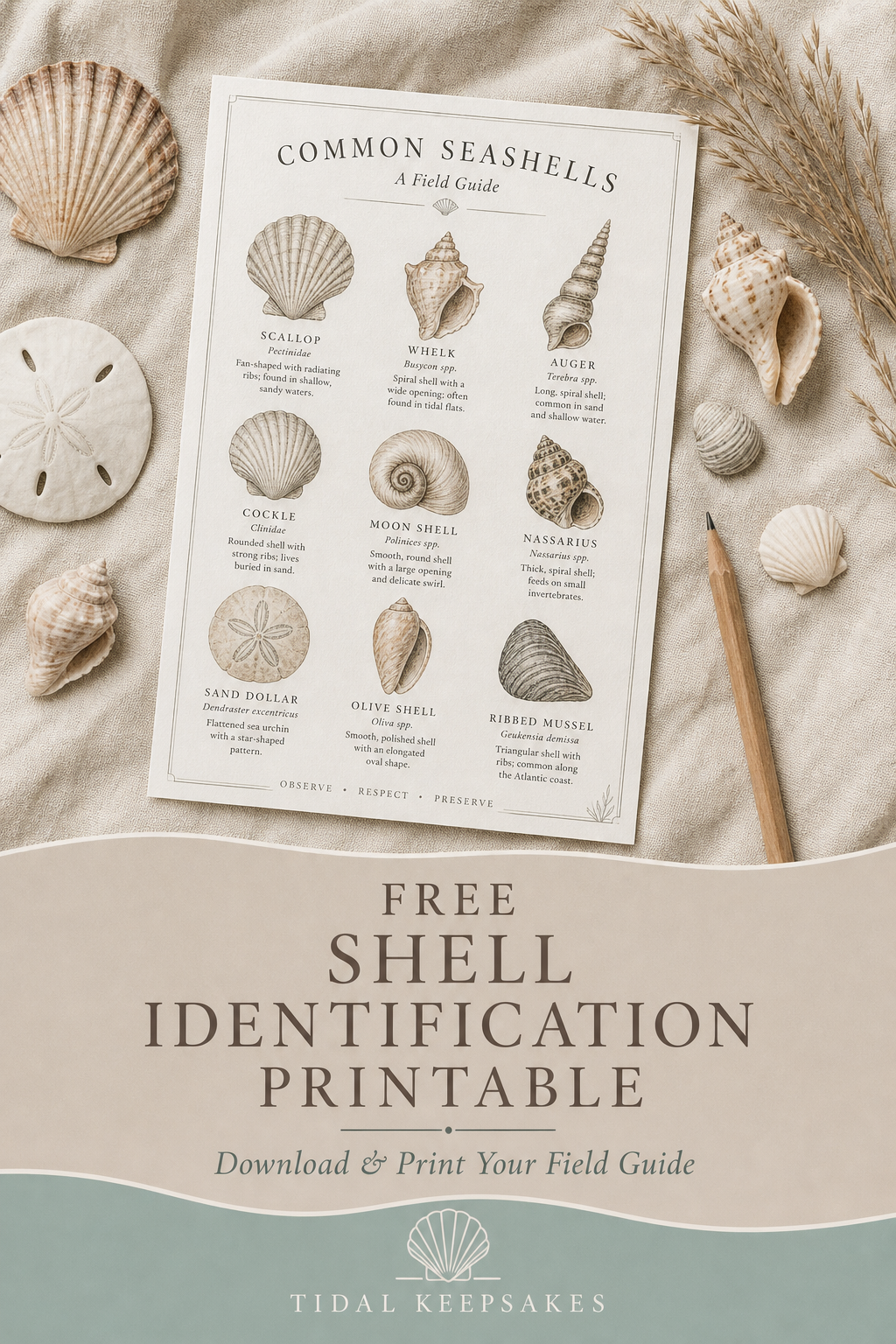
Free Shell Identification Printable
Builds on the same core topic.
Curated Shell Box
The Collector Box
See these ideas in a curated collection.
Compare Similar Shells
Species and look-alikes worth studying side by side. Every card routes into the shell reference.
Beaches Worth Exploring Next
Shores connected to the shells, regions, and conditions on this page.
North Carolina Outer Banks
Outer Banks
A 200-mile chain of Atlantic barrier islands — Cape Hatteras, Ocracoke, and Cape Lookout deliver whelks, olive shells, and the state shell,…
Explore BeachGeorgia Coast
Jekyll Island
Historic Golden Isle with generous public beaches — Driftwood Beach and St. Andrews shore deliver moon snails, jingle shells, and…
Explore BeachFlorida Gulf Coast
Sanibel Island
Sanibel's east-west orientation sweeps Gulf shells onto its shore in exceptional variety — the reason it's the most celebrated shelling…
Explore BeachNorth Carolina Outer Banks
Ocracoke Island
A ferry-only Outer Banks island south of Hatteras — sixteen miles of protected National Seashore beach where Scotch bonnets and knobbed…
Explore BeachDiscover More Coastal Inspiration
Curated coastal favorites and specimen boxes that echo the story above.
A Learning Journey to Follow
New to Beachcombing
For beginners · 5 steps
The pathway most first-time visitors take. It moves calmly from the beginner's guide into shell identification, then out to the beach and back home to the journal.
- 1
Start Here
Beginner's Beachcombing Guide
The foundation — what to bring, when to walk, how to look.
Continue - 2
Learn the Shells
Shell Identification Guide
Meet the species you're most likely to find on your first walk.
Continue - 3
Take Care of Finds
How to Clean Seashells
Bring shells home the right way so they last for years.
Continue - 4
Record the Walk
Shell Discovery Journal
Field-note every find while the memory is still fresh.
Continue - 5
Take the Coast Home
The Mini Box
A petite assorted shell collection, hand-gathered from the coast.
Continue