 Save
SaveGuide
Beginner Shells of the Florida Gulf Coast
The ten most common shells a first-time Florida Gulf beachcomber will actually find — with quick ID cues for each.
The ten most common shells a first-time Florida Gulf beachcomber will actually find — with quick ID cues for each.
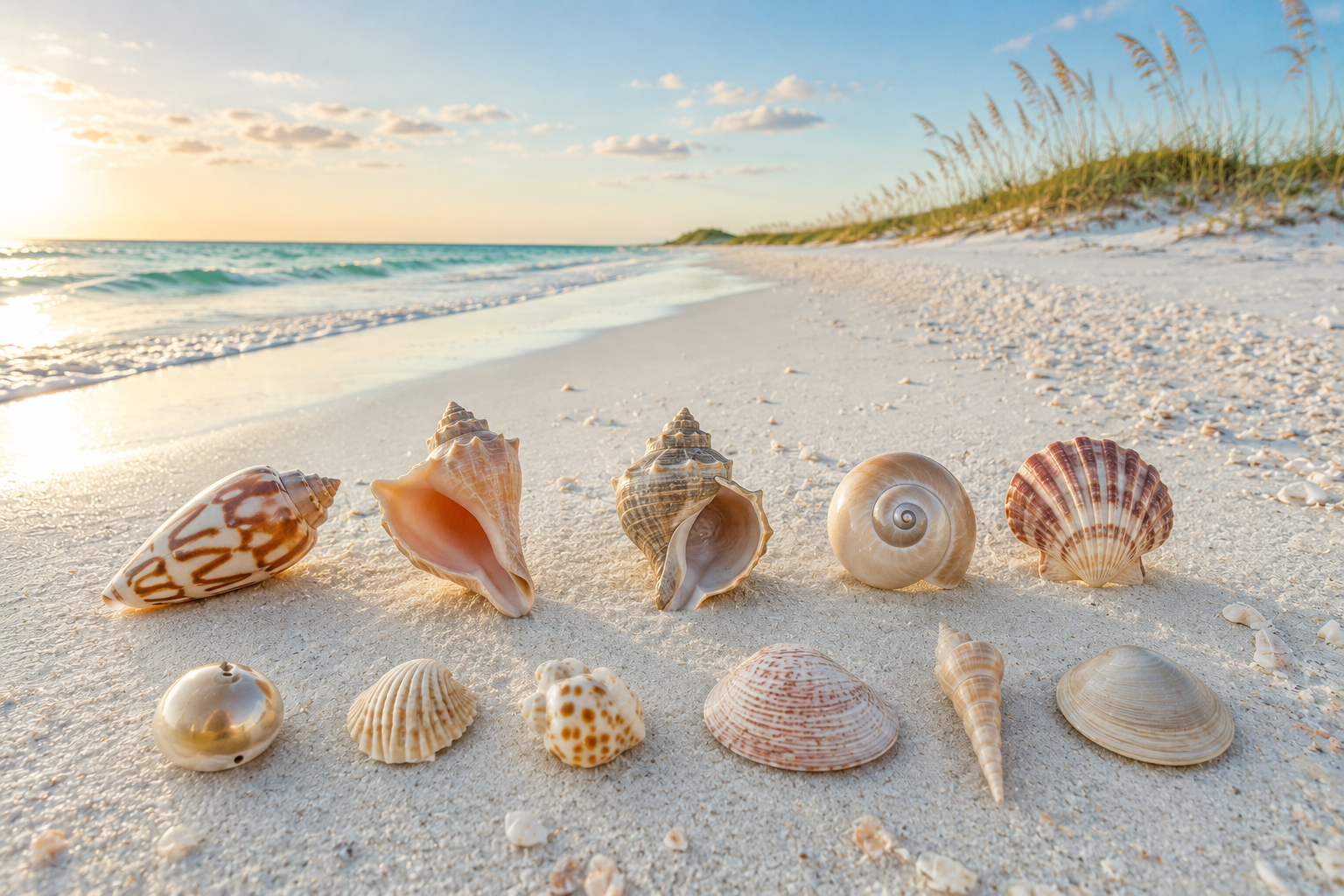
You don't need to memorize a field guide to enjoy your first shelling trip on Florida's Gulf coast. Ten shells account for the overwhelming majority of what you'll pick up between Marco Island and St. George Island. Learn the single cue that separates each one from everything else on the sand and you'll identify most of your finds before you leave the beach.
The Ten to Know
| Shell | Type | Size | The One Cue |
|---|---|---|---|
| Coquina (Donax variabilis) | Bivalve | Under 1 inch | Tiny wedge-shaped valves in every colour on one beach; paired shells open like a butterfly |
| Calico Scallop (Argopecten gibbus) | Bivalve | 1.5–2.5 inches | Deeply cupped fan with roughly 19–21 ribs and mottled pink, orange, and purple |
| Bay Scallop (Argopecten irradians) | Bivalve | 2–3 inches | Broader ribs — about 17–20 — with equal auricles and a darker upper valve |
| Ark Shell (family Arcidae) | Bivalve | 1–3 inches | Long straight hinge lined with many small teeth; turkey wings carry brown zigzag stripes |
| Cockle (family Cardiidae) | Bivalve | 1–3 inches | Strong radiating ribs; a paired cockle forms a heart seen edge-on |
| Lettered Olive (Americoliva sayana) | Gastropod | 2–3 inches | Glossy cylindrical shell with zigzag 'lettering' and a very short spire |
| Florida Fighting Conch (Strombus alatus) | Gastropod | 3–4 inches | Flared lip with a small U-shaped stromboid notch near the front; heavy for its size |
| Lightning Whelk (Sinistrofulgur sinistrum) | Gastropod | Large | Aperture opens on the LEFT with the spire pointing up — the only common left-handed whelk |
| Shark Eye (Neverita duplicata) | Gastropod | 1–3 inches | Round polished body whorl with a dark spiral 'pupil' at the apex |
| Banded Tulip (Cinctura lilium) | Gastropod | 2–4 inches | Smooth spindle with a few crisp dark spiral bands — no dense streaking |
Bivalves — Two-Piece Shells
Half of the ten are bivalves, and most Gulf tide lines are dominated by them. Start by sorting on outline: wedges are coquinas, fans are scallops, hearts are cockles, and the heavy trapezoid with the toothed hinge is an ark.
- Coquina — under an inch, triangular, and startlingly varied in colour: pink, yellow, blue, purple, white, often with radiating rays. They swarm the swash zone at Anna Maria Island, Siesta Key, Venice Beach, and Gulf Shores.
- Calico Scallop — the confetti of Sanibel's tide line. Small, deeply cupped, roughly 19–21 ribs, mottled in warm tones with a paler lower valve. Recorded at Sanibel, Captiva, Anna Maria Island, and Fort Myers Beach.
- Bay Scallop — a grass-flat scallop with fewer, broader ribs (about 17–20), prominent equal auricles at the hinge, and an upper valve mottled grey-brown to greenish. Recorded at Anna Maria Island, St. George Island, and Sanibel.
- Ark Shell — trapezoidal to elongate valves with strong radial ribs and a long straight hinge full of tiny tooth-like ridges. Often chalky white; the turkey wing carries brown zigzag stripes.
- Cockle — rounded triangular with strong radiating ribs in cream, tan, or pink-flushed tones. Robust and thick-walled, and unmistakable when you find both valves still joined.
Gastropods — Spiral Shells
The five spirals are where beginners gain the most ground, because each has a single feature that rules everything else out. Check the aperture — the opening — before you check the colour.
- Lettered Olive — polished, cylindrical, short spire, and an aperture running most of the shell's length. The zigzag lettering confirms it.
- Florida Fighting Conch — a solid orange to red-brown spindle with a flared, thickened outer lip and a shallow stromboid notch near the anterior end. Recorded at Sanibel, Captiva, Marco Island, Fort Myers Beach, and Honeymoon Island; winter and spring.
- Lightning Whelk — hold it spire up: if the aperture is on your left, it's a lightning whelk. Juveniles show vertical brown 'lightning' streaks that fade with age, and the anterior siphonal canal is long. Recorded at Sanibel, Captiva, Shell Key, and Padre Island.
- Shark Eye — a glossy globose moon snail with a low spire, a dark spiral 'eye' at the apex, and a callus partly filling the umbilicus on the underside. Pale tan to grey-blue.
- Banded Tulip — a slender smooth spindle with a few widely spaced dark brown to purplish spiral bands and a cream to orange aperture. Smaller and crisper than the true tulip.
Where and When to Practice
- Beginner-friendly Gulf beaches in our registry: Honeymoon Island, Fort Myers Beach, Anna Maria Island, Siesta Key, and Venice Beach — easy walking with plentiful small shells.
- Winter and spring are the recorded seasons for nearly every Florida Gulf beach; cold fronts push shells ashore and post-front mornings are the classic window.
- Walk the two hours either side of low tide, and go early — overnight deposits get picked over quickly.
- The 24 to 48 hours after a storm is the single most productive window in any season.
Look-Alikes to Expect
- Calico vs. bay scallop — count the ribs: roughly 19–21 and deeply cupped is calico; roughly 17–20 and broader is bay.
- Lightning whelk vs. other whelks — coil direction settles it. Left-handed is lightning; right-handed is knobbed or channelled.
- Banded tulip vs. true tulip — crisp, widely spaced bands is banded; dense irregular streaking on a larger shell is true tulip.
- Lettered olive vs. auger — olives are stout cylinders with a long aperture; augers are tall screw-like spires with a small basal opening.
- Shark eye vs. other moon snails — the callus partly filling the umbilicus is the shark eye's mark.
Collect Responsibly
- Check every gastropod for a live animal in the aperture before it goes in your bag — olives, conchs, whelks, and moon snails are all active predators.
- Live-shell collecting is prohibited on Sanibel and Captiva, and live-scallop harvest is regulated statewide in Florida.
- Take only empty shells, and leave the rest of the tide line for the next walker.
How to Practice
Pick up shells and sort them into these ten categories at the end of the walk — bivalves by outline, gastropods by aperture. After two or three tide-line walks you'll recognize each one instantly, and the eleventh shell you find will be the one worth looking up.
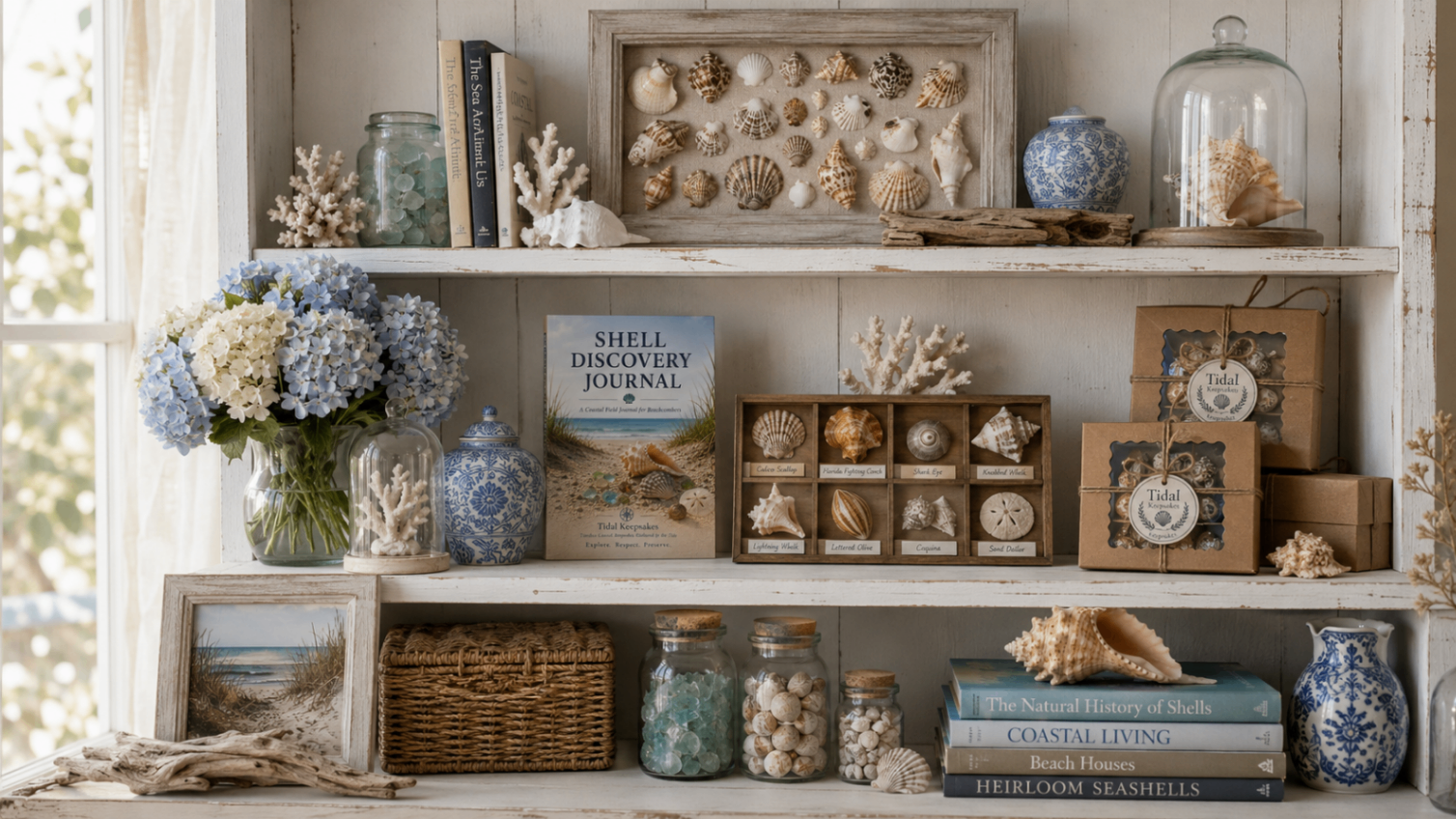
Log your first ten finds in a journal built for it.
Explore the Shell Discovery JournalReady to pick a shore? Our destination guide maps the Gulf beach by beach.
Read Best Beaches for ShellingContinue Your Beachcombing Journey
Hand-picked next steps — chosen because they build directly on what you've just read.
Article
Best Seashell Identification Books for Beach Lovers
Builds on the same core topic.
Guide
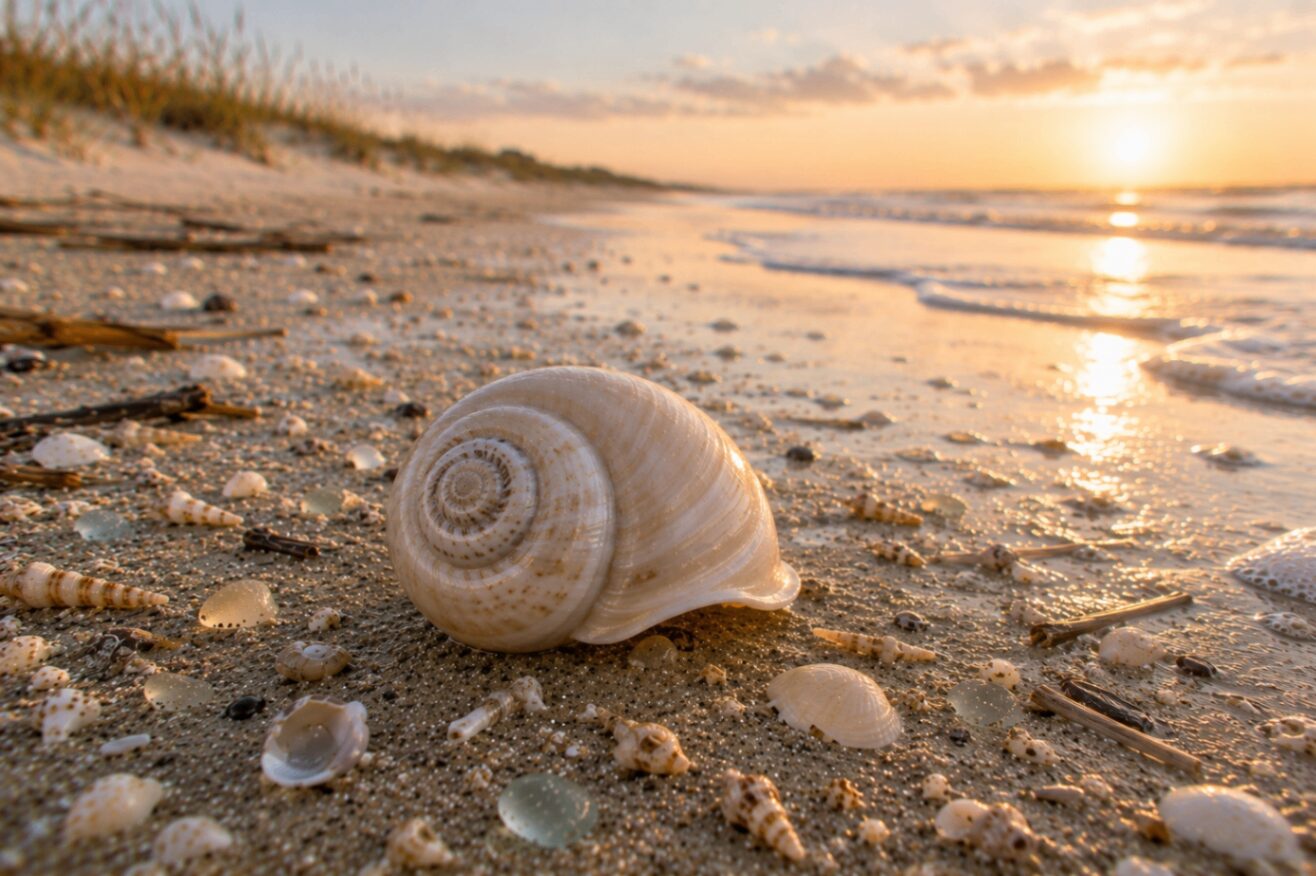
Shark Eye and “Atlantic Moon Snail”: Understanding the Names
Builds on the same core topic.
Resource
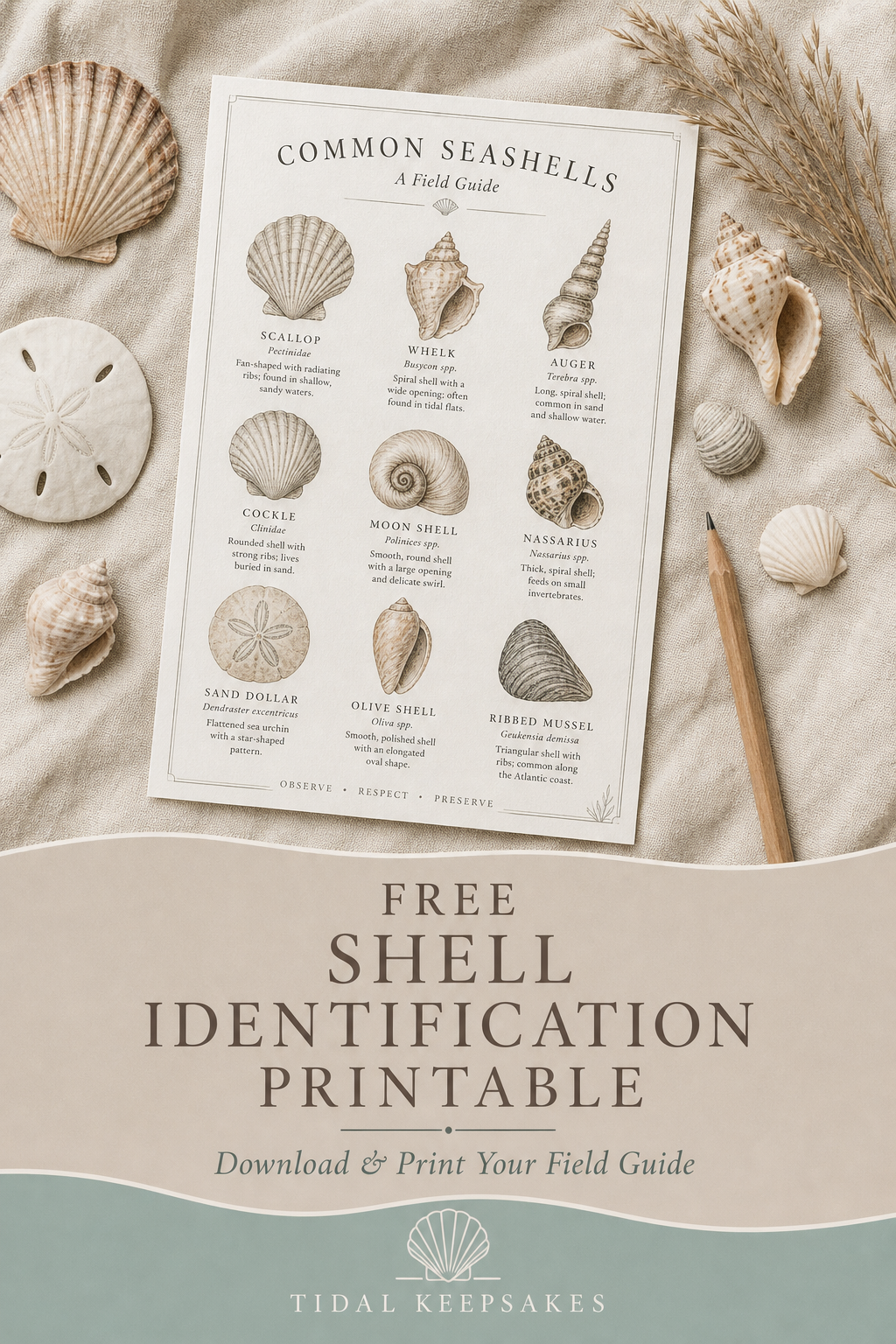
Free Shell Identification Printable
Builds on the same core topic.
Curated Shell Box
The Mini Box
See these ideas in a curated collection.
Compare Similar Shells
Species and look-alikes worth studying side by side. Every card routes into the shell reference.
Species
Scotch Bonnet
Semicassis granulata
Cream base with regular reddish-brown squares in tidy rows. Rounded body whorl and short spire; toothed inner lip.
Explore ShellSpecies
Knobbed Whelk
Busycon carica
Aperture opens on the right when the spire points up. Row of blunt knobs along the shoulder of the body whorl; interior often flushed with orange.
Explore ShellSpecies
Lettered Olive
Americoliva sayana
Cylindrical body with a very short spire and a long narrow aperture. The polished cream base carries tan or brown zigzag lines that give the species its 'lettered' name.
Explore ShellSpecies
Atlantic Auger
Terebra dislocata
Elongated screw-shaped shell up to 2 inches, pale grey to tan with faint spiral banding; each whorl carries fine axial ribs.
Explore ShellBeaches Worth Exploring Next
Shores connected to the shells, regions, and conditions on this page.
North Carolina Outer Banks
Outer Banks
A 200-mile chain of Atlantic barrier islands — Cape Hatteras, Ocracoke, and Cape Lookout deliver whelks, olive shells, and the state shell,…
Explore BeachGeorgia Coast
Jekyll Island
Historic Golden Isle with generous public beaches — Driftwood Beach and St. Andrews shore deliver moon snails, jingle shells, and…
Explore BeachFlorida Gulf Coast
Sanibel Island
Sanibel's east-west orientation sweeps Gulf shells onto its shore in exceptional variety — the reason it's the most celebrated shelling…
Explore BeachNorth Carolina Outer Banks
Ocracoke Island
A ferry-only Outer Banks island south of Hatteras — sixteen miles of protected National Seashore beach where Scotch bonnets and knobbed…
Explore BeachDiscover More Coastal Inspiration
Curated coastal favorites and specimen boxes that echo the story above.
A Learning Journey to Follow
New to Beachcombing
For beginners · 5 steps
The pathway most first-time visitors take. It moves calmly from the beginner's guide into shell identification, then out to the beach and back home to the journal.
- 1
Start Here
Beginner's Beachcombing Guide
The foundation — what to bring, when to walk, how to look.
Continue - 2
Learn the Shells
Shell Identification Guide
Meet the species you're most likely to find on your first walk.
Continue - 3
Take Care of Finds
How to Clean Seashells
Bring shells home the right way so they last for years.
Continue - 4
Record the Walk
Shell Discovery Journal
Field-note every find while the memory is still fresh.
Continue - 5
Take the Coast Home
The Mini Box
A petite assorted shell collection, hand-gathered from the coast.
Continue