Guide
True Tulip vs. Banded Tulip
Florida's two common tulip shells share a family and a silhouette. The pattern gives them away.
Florida's two common tulip shells share a family and a silhouette. The pattern gives them away.
Start Here: Read the Pattern
Both belong to the family Fasciolariidae and share the smooth spindle silhouette, so shape will not separate them. Colour pattern is the deciding factor: irregular streaks and blotches mean true tulip, a few crisp spiral bands mean banded tulip.
What the Two Shells Share
- Same family (Fasciolariidae) and the same smooth spindle shape with a moderately tall spire.
- Smooth, unridged shoulder on both — no strong ridges between the whorls.
- Both live in shallow Gulf sandy-subtidal bottoms and grass flats.
- Both wash up on the same Gulf beaches, including Sanibel, Captiva, and Caladesi Island.
How to Identify a True Tulip
The true tulip (Fasciolaria tulipa) is the larger of Florida's two common tulips — an elongate, smooth shell with fine spiral incised lines and a cream to greyish base overlaid with irregular brown streaks and blotches. Adults are commonly 3–7 inches and can exceed 9 inches.
- Cream base with irregular brown streaks and blotches — messy, not banded.
- Fine spiral incised lines rather than strong ridges.
- Commonly 3–7 inches; occasionally over 9 inches.
- Range extends across the Gulf, southeast, and Caribbean.
How to Identify a Banded Tulip
The banded tulip (Cinctura lilium) is the smaller, more crisply patterned of the pair — a slender spindle shell up to about 4 inches with a smooth surface and a few widely spaced dark brown to purplish spiral bands. The aperture runs cream to orange, and the anterior canal is relatively short.
- A few crisp, widely spaced dark spiral bands — no dense streaking.
- Usually 2–4 inches, noticeably smaller than an adult true tulip.
- Smooth surface; spire moderately tall, anterior canal relatively short.
- Aperture cream to orange.
Key Differences at a Glance
| Feature | True Tulip | Banded Tulip |
|---|---|---|
| Scientific name | Fasciolaria tulipa | Cinctura lilium |
| Typical size | 3–7 in (up to 9 in) | 2–4 in |
| Surface pattern | Cream with irregular brown streaks & blotches | Cream with a few crisp dark spiral bands |
| Surface detail | Fine spiral incised lines | Smooth |
| Aperture | Often orange to salmon | Cream to orange |
| Shoulder | Smooth, unridged | Smooth, unridged |
| Habitat | Sandy subtidal, grass flats | Sandy subtidal, grass flats |
| Common region | Gulf, southeast, Caribbean | Gulf and southeast |
| Best field mark | Irregular streaking on a larger shell | Crisp spiral banding on a smaller shell |
Where They Are Commonly Confused
The two overlap in habitat and wash in on the same beaches, so you will often see both in a single morning's finds. Juvenile true tulips fall inside the banded tulip's size range, which removes size as a shortcut — at that point the pattern is the only reliable read. Heavily beach-worn shells can lose enough colour that neither pattern is legible; those are best logged as 'tulip, species uncertain' rather than guessed.
Which One Did You Find?
- Messy brown streaks and blotches on a cream shell, 3 inches or more — true tulip.
- A handful of clean dark spiral bands on a smaller, slender shell — banded tulip.
- Rule of thumb: streaky and larger = true tulip; banded and smaller = banded tulip.
- Pattern too worn to read? Log it as an uncertain tulip and photograph both sides.
True tulips are predatory — check the aperture and return live specimens to the seagrass before you keep anything.
More look-alike pairs, each with the one field mark that settles it.
Commonly Confused ShellsContinue Your Beachcombing Journey
Hand-picked next steps — chosen because they build directly on what you've just read.
Article
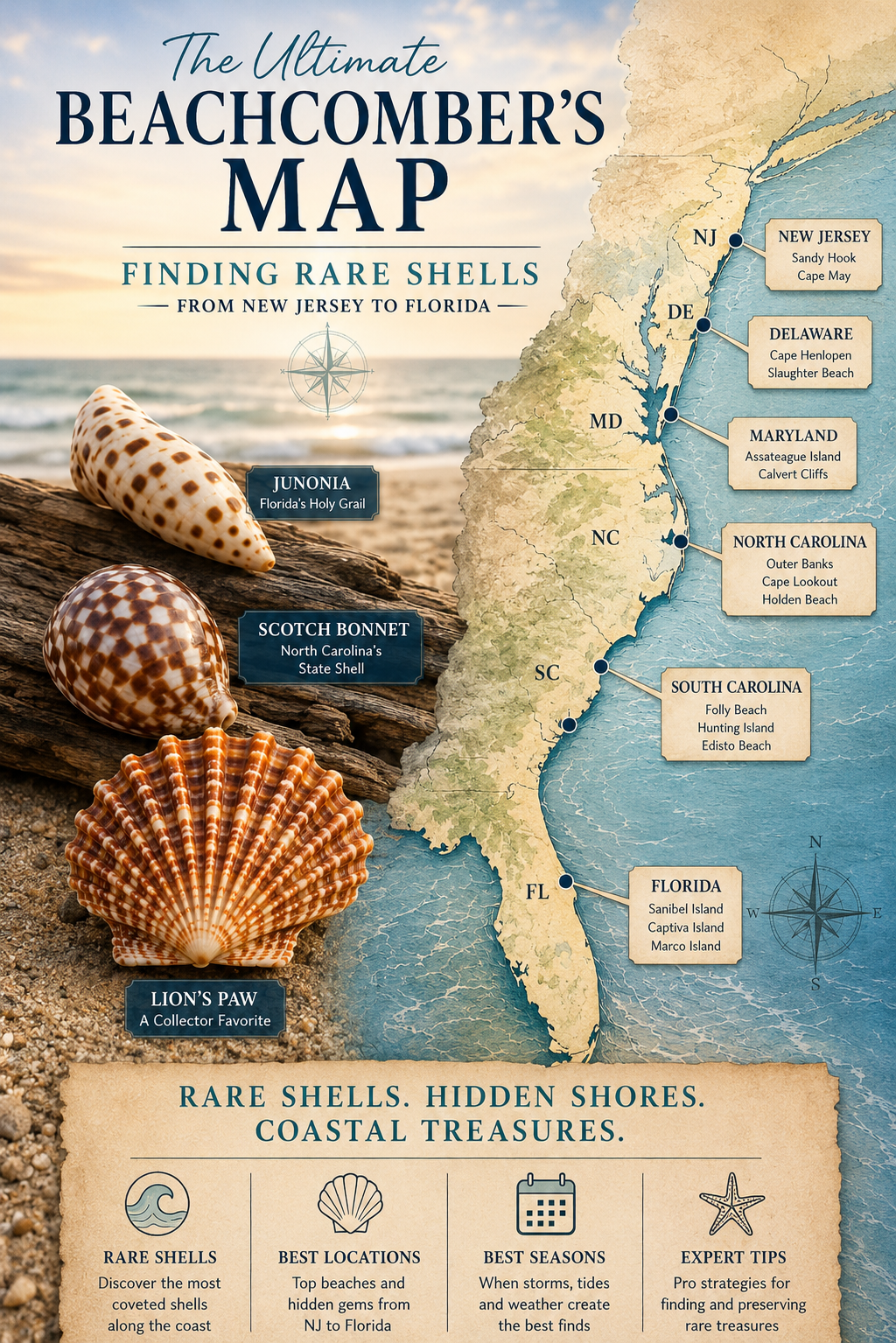
The Ultimate Beachcomber's Map: Finding Rare Shells from Jersey to Florida
Builds on the same core topic.
Guide
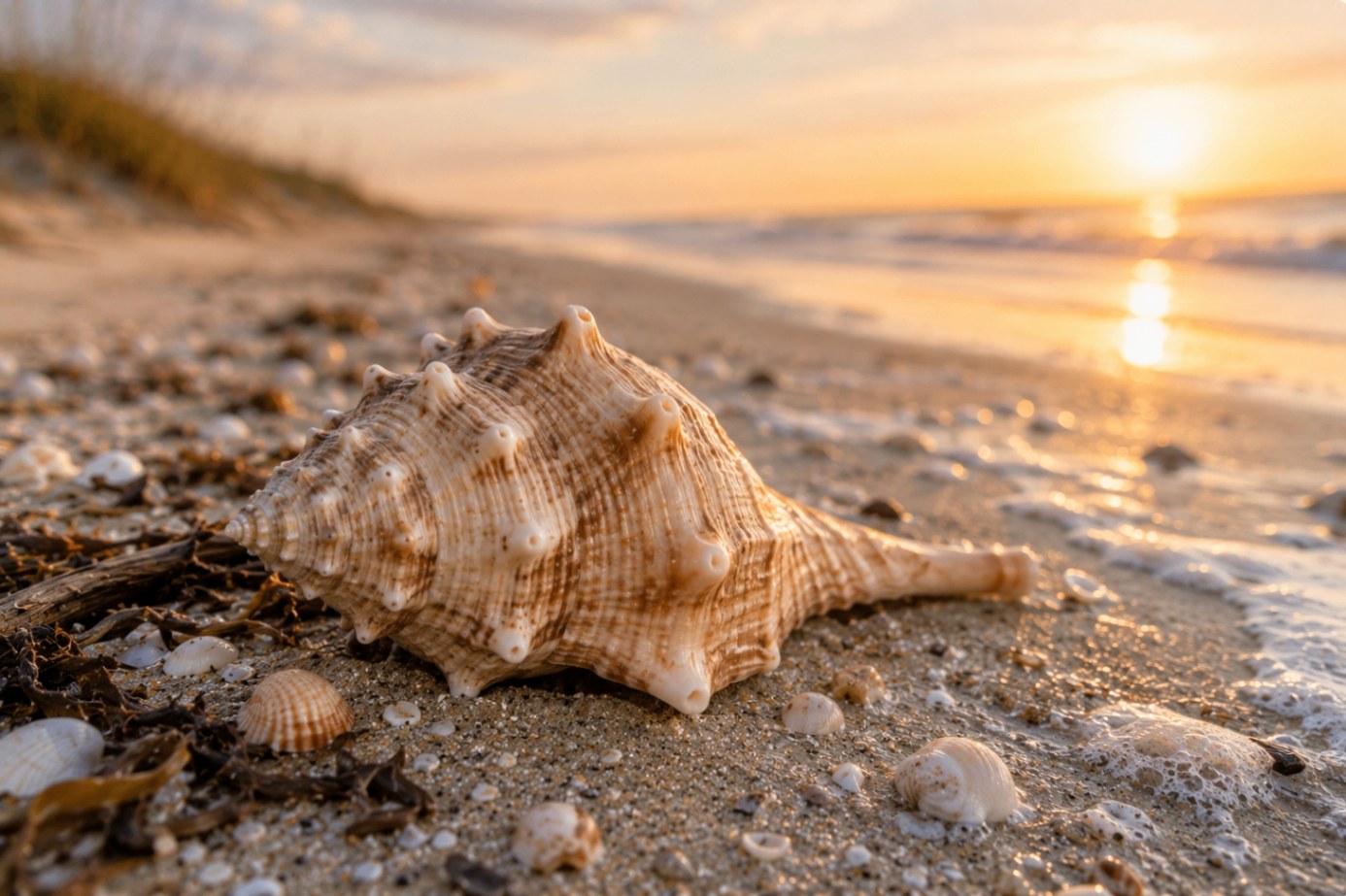
Commonly Confused Shells: A Side-by-Side Field Guide
Hand-picked next step from the editors.
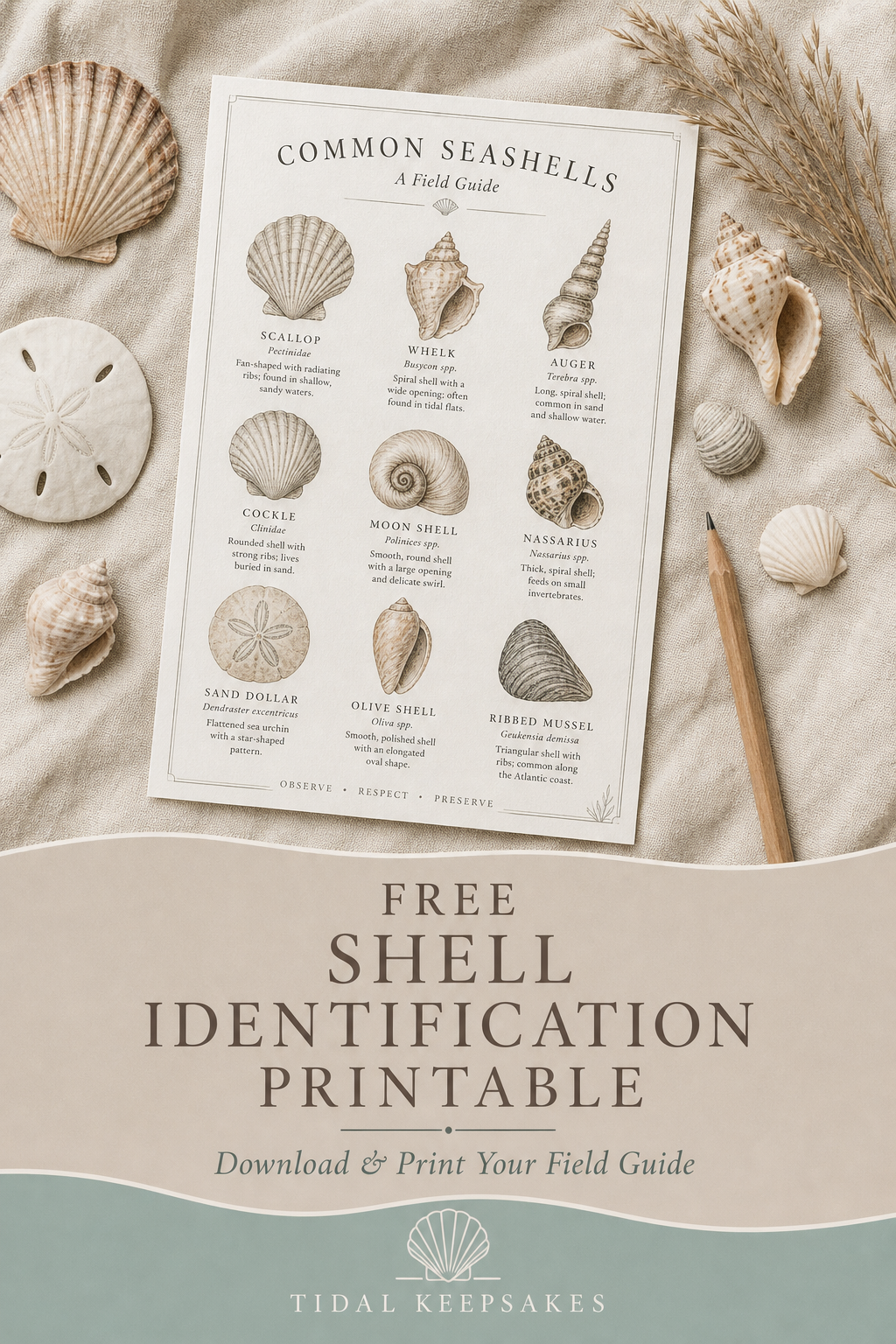
Resource
Free Shell Identification Printable
Builds on the same core topic.
Curated Shell Box
The Collector Box
See these ideas in a curated collection.
Compare Similar Shells
Species and look-alikes worth studying side by side. Every card routes into the shell reference.
Species
Florida Horse Conch
Triplofusus giganteus
Similar in shape to the True Tulip.
Explore ShellSpecies
Lightning Whelk
Sinistrofulgur sinistrum
Related shell in the coastal collection.
Explore ShellGroup
Whelk
Related shell in the coastal collection.
Explore ShellFamily
Moon Snail
Related shell in the coastal collection.
Explore ShellBeaches Worth Exploring Next
Shores connected to the shells, regions, and conditions on this page.
North Carolina Outer Banks
Outer Banks
A 200-mile chain of Atlantic barrier islands — Cape Hatteras, Ocracoke, and Cape Lookout deliver whelks, olive shells, and the state shell,…
Explore BeachGeorgia Coast
Jekyll Island
Historic Golden Isle with generous public beaches — Driftwood Beach and St. Andrews shore deliver moon snails, jingle shells, and…
Explore BeachFlorida Gulf Coast
Sanibel Island
Sanibel's east-west orientation sweeps Gulf shells onto its shore in exceptional variety — the reason it's the most celebrated shelling…
Explore BeachNorth Carolina Outer Banks
Ocracoke Island
A ferry-only Outer Banks island south of Hatteras — sixteen miles of protected National Seashore beach where Scotch bonnets and knobbed…
Explore BeachDiscover More Coastal Inspiration
Curated coastal favorites and specimen boxes that echo the story above.
A Learning Journey to Follow
Learning Shell Identification
For growing collectors · 5 steps
For readers who already know a scallop from a whelk and want to sharpen the edge cases. Ends at the journal, where identification becomes a practice, not a lookup.
- 1
Understand the Anatomy
Shell Identification Guide
Vocabulary first — apex, whorl, aperture, columella.
Continue - 2
Meet the Common Species
Explore Common Shells
Browse the canonical shell records the site is built on.
Continue - 3
Compare Look-Alikes
Commonly Confused Shells
Side-by-side markers for the pairs that trip up new collectors.
Continue - 4
Find Them in the Wild
Best Beaches for Shelling
Where each species actually washes up.
Continue - 5
Practice in the Field
Shell Discovery Journal
Record each ID with sketches and notes to lock the learning in.
Continue