 Save
SaveGuide
Seasonal Shelling Calendar
What to look for season by season — a year-round calendar for East Coast beachcombers.
What to look for season by season — a year-round calendar for East Coast beachcombers.
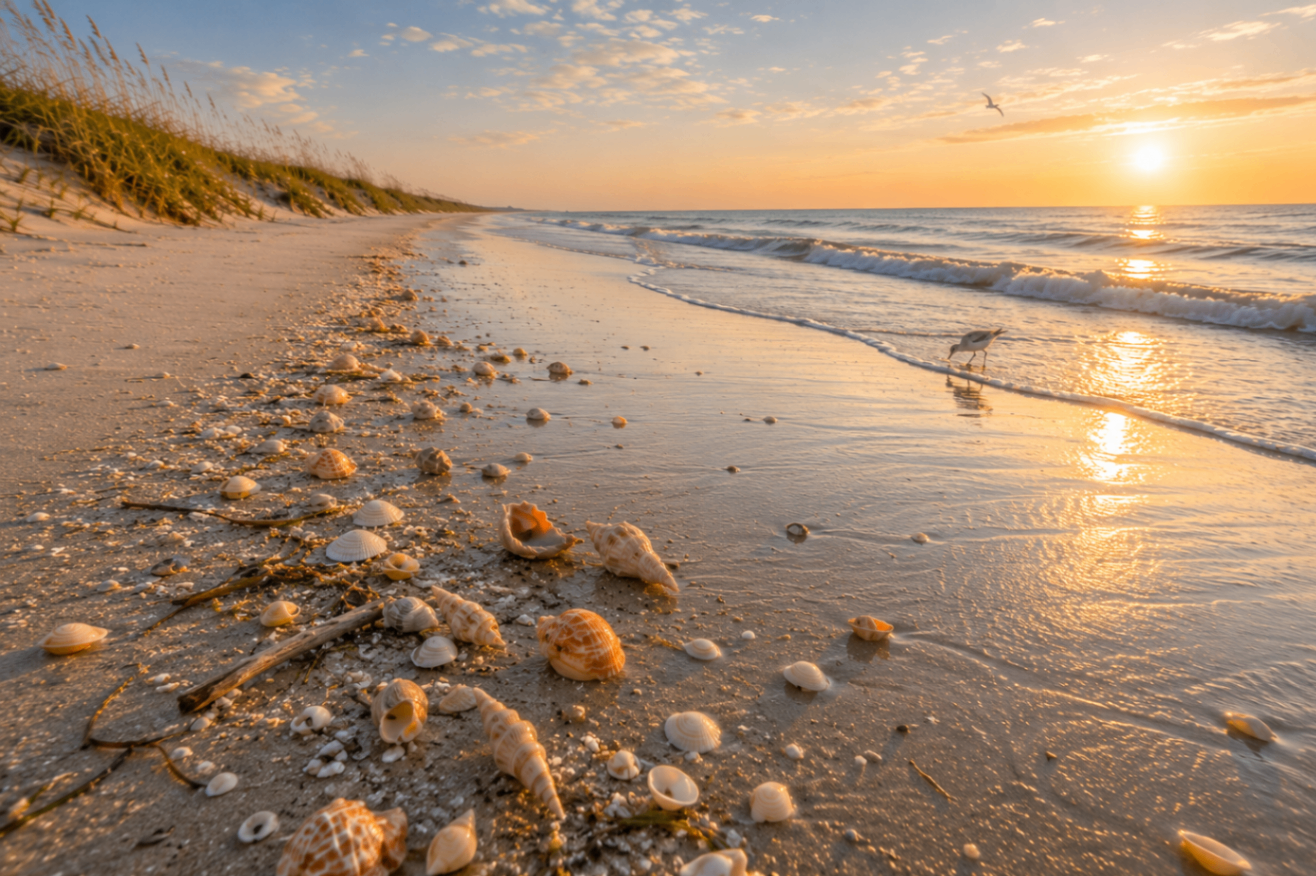
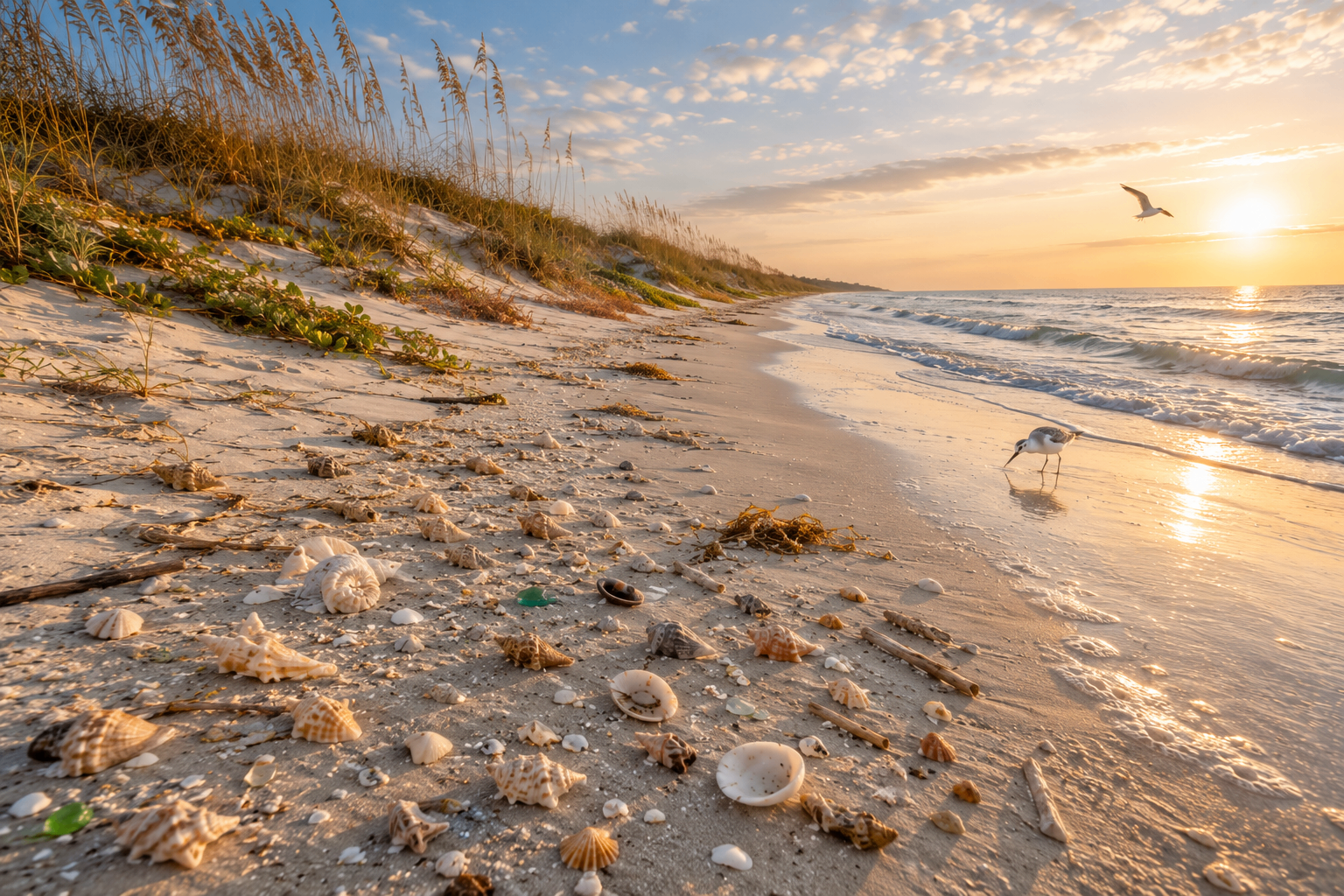
Every season has its own rhythm on the shore. This calendar is built from the seasons recorded for each beach and shell in the Tidal Keepsakes registry, plus the timing guidance in our tide and best-time guides. It is a planning reference, not a forecast — conditions on any given week decide the walk.
How to Use This Calendar
- Start with the season to pick a region, then use tide and weather to pick the morning.
- Where a season is listed for a beach, it means that beach is recorded as shelling well in that season — not that other seasons are empty.
- Storms and onshore winds override the calendar. The 24 to 48 hours after a system is the most productive window in any season.
Winter — December through February
Winter is the anchor of the shelling year on the Gulf. Cold fronts from November through March push Gulf water over shallow shell beds and drop new shells on the beach as they retreat, which is why almost every Florida Gulf beach in our registry lists winter among its recorded seasons — Sanibel, Captiva, Shell Key, Caladesi, Honeymoon Island, Marco, and the rest. Post-front mornings, cold and clear and calm, are the classic window, and low tide before dawn after a front is the traditional Sanibel walk.
- Regions recorded for winter: Florida Gulf Coast, Florida Panhandle, Florida Atlantic Coast, Georgia coast, South Carolina Lowcountry, North Carolina, Mid-Atlantic (Assateague), Texas.
- Winter also brings the quietest beaches of the year — overnight deposits stay untouched longer.
- In the Carolinas the winter driver is the nor'easter rather than the cold front; walk the morning after.
Spring — March through May
Spring is the most widely recorded season across the whole registry: every Gulf beach we cover lists it, as do the Atlantic Florida, Georgia, Carolina, and New Jersey beaches. Late-season fronts still reach the Gulf through March, and the Carolinas and Mid-Atlantic warm into comfortable early-morning walking. On Padre Island, sargassum arrivals in late spring often carry offshore shells to the strand.
- Regions recorded for spring: every region in our beach registry.
- Lettered olives, lightning whelks, coquinas, and fighting conchs all list spring among their recorded seasons.
- Cape May and Sandy Hook record spring and fall only — this is one of their two windows.
Summer — June through August
Summer is the least-represented season in our records, and we would rather say so than invent activity. Gulf Shores, Alabama is the only beach in the registry that lists summer among its recorded seasons. Summer visitors elsewhere will still find shells — the Gulf's own best-time guide is explicit that they simply won't see the quantity or variety a February collector sees. On the shell side, lettered olives, lightning whelks, and coquinas do carry summer in their recorded seasons, so small, glossy, and plentiful is the realistic summer goal.
- Regions recorded for summer: Alabama Gulf Coast.
- Shells with summer in their record: lettered olive, lightning whelk, coquina.
- Summer strategy: go earlier. Sunrise walks beat foot traffic, and the swash zone still yields coquinas, augers, and small bivalves.
Fall — September through November
Fall opens the Atlantic season. Every Georgia, Carolina, Florida Atlantic, and South Carolina beach in the registry lists fall first among its recorded seasons, and the Outer Banks records post-nor'easter mornings as its classic window. Tropical systems matter here: Emerald Isle's record notes that after tropical systems, augers and knobbed whelks reach the strand in numbers not seen at any other time of year. On the Gulf, the family beaches — Anna Maria, Siesta Key, Venice, Honeymoon Island — carry fall in their records as fronts begin to return.
- Regions recorded for fall: Florida Atlantic Coast, Georgia coast, South Carolina Lowcountry, North Carolina, Mid-Atlantic, Florida Panhandle, parts of the Florida Gulf Coast, Alabama, Texas.
- Crowds thin after Labor Day while the water is still comfortable.
- Fall is the season to plan around a weather system rather than a date.
Season-by-Season Reference
| Season | Conditions to Watch | Regions Recorded | Related Guide |
|---|---|---|---|
| Winter | Cold fronts and post-front mornings on the Gulf; nor'easters on the Atlantic | Florida Gulf and Panhandle, Florida Atlantic, Georgia, South Carolina, North Carolina, Assateague, Texas | Best Time to Go Shelling on Florida's Gulf Coast |
| Spring | Late fronts, spring tides around new and full moons, sargassum arrivals on Padre Island | Every region in the registry | How Tides Affect Shelling |
| Summer | Calm surf; early starts matter most | Alabama Gulf Coast | Best Time to Find Seashells |
| Fall | Nor'easters and tropical systems; thinning crowds | Florida Atlantic, Georgia, South Carolina, North Carolina, Mid-Atlantic, Florida Panhandle and Gulf family beaches | Best Beaches for Shelling |
Conditions That Matter All Year
- Tide — the two hours before and after low tide expose the most shoreline. Spring tides, around new and full moons, have the widest range; neap tides reveal less.
- Storms — wind and waves stir the seafloor, and the 24 to 48 hours afterwards is widely considered the best shelling window of all.
- Time of day — arriving just after sunrise gives you first access to overnight deposits.
- Wind direction — a strong onshore wind the day before is worth more than a date on the calendar.
- Footfall — a tide line already walked is a different beach; head away from the access points.
Regional Differences
- Florida Gulf Coast — winter and spring, driven by cold fronts; the deepest coverage in our registry.
- Florida Atlantic Coast, Georgia, and the Carolinas — fall through spring, driven by nor'easters and tropical systems.
- Mid-Atlantic — Assateague records fall through spring; Cape May and Sandy Hook record spring and fall.
- Alabama and Texas Gulf — Gulf Shores records spring, summer, and fall; Padre Island records winter, spring, and fall.
Once you've picked a season, pick the shore. Our destination guide maps every beach in the registry by region.
Read Best Beaches for ShellingThen time the morning itself — tides decide how much beach you get to walk.
Read How Tides Affect ShellingPlan your year on the shore with our Beginner's Beachcombing Guide.
Read the Beachcombing GuideContinue Your Beachcombing Journey
Hand-picked next steps — chosen because they build directly on what you've just read.
Compare Similar Shells
Species and look-alikes worth studying side by side. Every card routes into the shell reference.
Species
Scotch Bonnet
Semicassis granulata
Cream base with regular reddish-brown squares in tidy rows. Rounded body whorl and short spire; toothed inner lip.
Explore ShellSpecies
Knobbed Whelk
Busycon carica
Aperture opens on the right when the spire points up. Row of blunt knobs along the shoulder of the body whorl; interior often flushed with orange.
Explore ShellSpecies
Lettered Olive
Americoliva sayana
Cylindrical body with a very short spire and a long narrow aperture. The polished cream base carries tan or brown zigzag lines that give the species its 'lettered' name.
Explore ShellSpecies
Atlantic Auger
Terebra dislocata
Elongated screw-shaped shell up to 2 inches, pale grey to tan with faint spiral banding; each whorl carries fine axial ribs.
Explore ShellBeaches Worth Exploring Next
Shores connected to the shells, regions, and conditions on this page.
North Carolina Outer Banks
Outer Banks
A 200-mile chain of Atlantic barrier islands — Cape Hatteras, Ocracoke, and Cape Lookout deliver whelks, olive shells, and the state shell,…
Explore BeachGeorgia Coast
Jekyll Island
Historic Golden Isle with generous public beaches — Driftwood Beach and St. Andrews shore deliver moon snails, jingle shells, and…
Explore BeachFlorida Gulf Coast
Sanibel Island
Sanibel's east-west orientation sweeps Gulf shells onto its shore in exceptional variety — the reason it's the most celebrated shelling…
Explore BeachNorth Carolina Outer Banks
Ocracoke Island
A ferry-only Outer Banks island south of Hatteras — sixteen miles of protected National Seashore beach where Scotch bonnets and knobbed…
Explore BeachDiscover More Coastal Inspiration
Curated coastal favorites and specimen boxes that echo the story above.
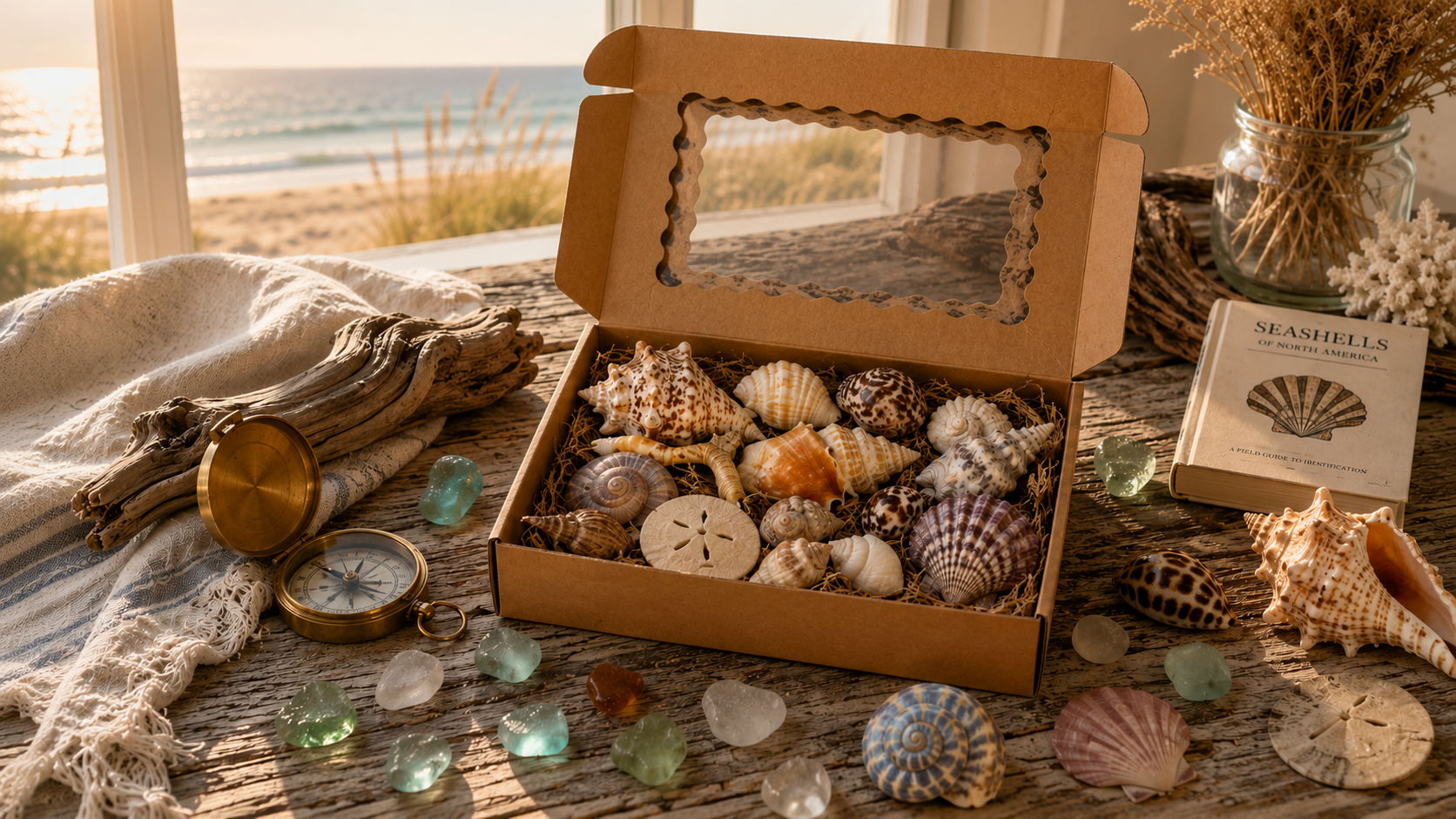
A Learning Journey to Follow
Learning Shell Identification
For growing collectors · 5 steps
For readers who already know a scallop from a whelk and want to sharpen the edge cases. Ends at the journal, where identification becomes a practice, not a lookup.
- 1
Understand the Anatomy
Shell Identification Guide
Vocabulary first — apex, whorl, aperture, columella.
Continue - 2
Meet the Common Species
Explore Common Shells
Browse the canonical shell records the site is built on.
Continue - 3
Compare Look-Alikes
Commonly Confused Shells
Side-by-side markers for the pairs that trip up new collectors.
Continue - 4
Find Them in the Wild
Best Beaches for Shelling
Where each species actually washes up.
Continue - 5
Practice in the Field
Shell Discovery Journal
Record each ID with sketches and notes to lock the learning in.
Continue